
Shoe, Leather and Accessory Glossary
Annonay Tannery
A renowned tannery in Annonay, Auvergne-Rhône-Alpes, France. Established in 1838 the tannery is well known for its high quality box calf leather.
Apron Toe

An Apron toe can be recognized by the visible edges or stitching that finishes off the toe and forms a sort of apron along the shoe's front.
Balmoral

A Balmoral is a type of Oxford. Both boots and shoes can feature this styling.
The Balmoral features a vamp which runs all the way to the back of the shoe - resulting in a horizontal seam - seen in this suede Balmoral boot from Carmina.
Barkerflex

Barkerflex is a special Barker version of the welted construction. By adjusting the 'lasting' and 'making' process, the sole is cemented and not stitched. This allows for a closer sole edge and a lighter sole, giving a finer looking, more flexible shoe - while still retaining the advantages of welted shoes. Softly, Softly The softness of the leather forepart on cork delivers just the right amount of softness under foot. It also gives the right degree of shock absorption. Flexibility The shoe bends naturally, along with the ball of the foot, thanks to the soft leather forepart insole and the slashed outer sole. Supreme Comfort The shape and retention properties of a formal Goodyear Welted shoe, combined with Barker's unique flexible forepart, offer supreme comfort. Keep in shape The shoe achieves a highly personal footbed, actually taking on the shape of your foot because the upper leather rests on cork. Breathe in, Breathe out Your feet will be able to breathe thanks to the properties of the cork and leather which let moisture escape naturally.
Bellows Tongue
A shoe tongue that is attached to the shoe at the sides as well as at the bottom. Used in walking boots and some country styles to keep out debris and improve waterproofing.
Blake Stitched

In a shoe that is Blake stitched, the sole is attached directly to the upper of the shoe, rather than to an intermediary welt. This makes for a lightweight shoe with the sole thinner and more flexible, but by definition less robust.
Blucher
The blucher is similar to the Derby shoe. They both feature 'open throat' lacing, but with the blucher, the uppers are constructed from a single cut - with just small eyelet facings being sown on - in contrast to the larger sown on facings in the Derby.
The blucher is named after the 18th-century Prussian field marshal Gebhard Leberecht von Blücher who wanted more comfortable footwear for his troops. This design was adopted by armies across Europe.
Brogue

Despite their association with Northampton English shoe manufactures, brogue (or wingtips as they are called in the US) are thought to originate from Scotland and Ireland. Originally a country shoe, the holes in the brogue pattern were to help drain water when walking over boggy land. They are no longer the preserve of the country gentleman - being enthusiastically adopted by the city and the world of fashion.
Full Brogue
The image above is an Oxford full brogue. A full brogue has a pointed toe cap with extensions (or wings) which run down the site of the shoe. The toe cap is perforated in patterns and has a serrated edge.
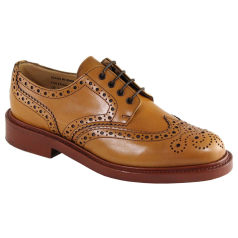
The image above is a full brogue Derby style.
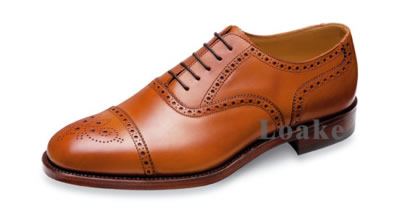
Semi Brogue or Half Brogue
The semi-brogue has a less elaborate toe cap with a serrated edge and is decorated with perforations.
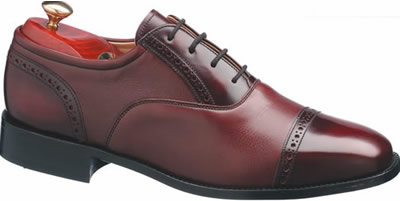
Quarter Brogue
The quarter brogue has a toe cap with a perforated and serrated edge, but the toe itself is not decorated.
Long Wing Brogue
A variant of the full brogue, the long wing brogue features ‘wings’ which extend along the entire length of the shoe. This style has fans on both sides of the Atlantic, but traditionally it has been favoured in the US.
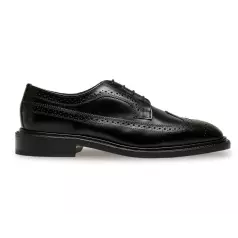
Burnished Leather

A process where the shoe surface is buffed to achieve an antiquing effect of the leather, a type of leather finish that creates a contrasting, rubbed-off appearance with variation of shade.
Calf Leather

The skin of very young cattle which offers fine grain, suppleness and exceptional durability. A versatile leather that can be used for virtually every type of shoe.
Calf leather tends to retain it's colour and is often considered to improve in appearance with age.
Caoutchouc
Caoutchouc is the french term for natural rubber. Natual rubber is harvested from the Para rubber tree in the form of latex and then refined before being used in footwear.
Cemented Construction

A construction using specialised adhesives, in place of stitched welts, to bond the upper parts and soles, thus achieving lightness and flexibility.
Commando Sole

Rubber sole unit in a pattern tried and trusted by the military. The sole is also popular in many country style shoes, and has also become a fashion feature.
The grip provides good wear and grip characteristics as well as cushioning.
Cordovan

Known for its non-porosity, density, and good wearing characteristics, Cordovan leather is used in the manufacture of fine shoes. The name derives from Cordoba, Spain, where the leather was first produced. A soft, fine-grained, coloured leather produced mainly from the shell of a horse butt.
Corrected Grain Leather
Leather which has been sanded or buffed to remove imperfections. The outermost layer is sanded down or scraped away revealing a uniform surface below which may then be pigmented or have a synthetic polymer applied.
Dainite
 The term Dainite is usually used to describe a studded sole unit made by Harboro Rubber Company Ltd in Market Harborough, England. However, several other types of Dainite sole are made by the same company including the Medway and Ridgeway. See www.dainite.com/ for more details.
 Derby

A shoe with two side panels or "quarters" which are laced together over the tongue. The lacing is 'open-throat' (not stitched together at the bottom) and allows for more adjustment or 'give' around the instep than 'closed-throat' 'Oxford' 'V'-shaped lacing. Also known as a Gibson. The Blucher is a similar style of construction.
Dressing
After drying out the leather after tanning the leather is dressed. This could involve: 1. Completely softening the leather (taking out any area of hardness that may be left in). This is achieved by hand or machine process called staking, in which the leather is flexed and pulled. 2. Final colouring. 3. Buffing up the flesh side with abrasives to produce a nap finish (suede). 4. Rolling and glazing to produce a high gloss by flattening out and smoothing the grain surface (grain leather). 5. Pigmenting the leather to cover outstanding imperfections. 6. Correcting grain side leather by abrading the grain surface to give a more uniform and less marked appearance. 7. Patented polyurethane finishes which produce easy care - 'wipe clean' and 'wet look' leathers.
Fittings or Widths
With reference to shoe fittings or widths of the manufacturers on our website C or D narrow E or Ex slightly more narrow than the average 5 or F average Fx slightly wider than the average 6 or G wide GX slightly wider still H extra wide
Full-Grain Leather
Skins where only the hair has been removed, leaving the natural surface grain unchanged.
Goodyear Welted

Goodyear welted footwear construction dates back to the late 1800s. In 1869, the American inventor Charles Goodyear Jr. filed a patent for the machine used to stitch the footwear.
Involving over 150 processes, many conducted entirely by hand, the essence of this construction is that the upper is shaped over the last and secured by sewing a strip of leather or 'welt' to the upper and inner sole. The process is then completed by separately attaching a sole to the welt.
The resulting footwear possesses improved thermal insulation, durability, flexibility, shape retention, and breathability.
The more a Goodyear welted shoe is worn, the more comfortable it becomes as the leather components gradually mould to the foot's shape.
It is also possible to resole a pair of worn Goodyear Welted shoes or boots by stitching new soles to the existing welts, thereby increasing their life expectancy.
(Photo Credit CrockettandJones.com)
* Charles Goodyear Jr was the son of Charles Goodyear, the inventor of vulcanised rubber (after whom the Goodyear tyre company was named),
JR-Leather Sole
Oak bark tanned leather soles made by Joh. Rendenbach Jr & Co.
The leather tanned by this process takes up to nine months during which the hides are placed in oak bark lined pits. The process has been in use for over 140 years.
JR soles are renowned for their flexibility and therefore comfort, in addition to their longevity.
Kid Leather
 The skin of young goats, which offers fine grain and suppleness, predominantly used for casual and lightweight shoes.
 Last
The wooden form around which a shoe is fashioned. The last represents the shape and size of the intended wearer's foot.
Leather
Leather is a natural product. Like real wood and wool it has a life of its own with a distinctive quality look. Leather is both protective and uniquely comfortable. Leather shoes retain their shape and grow old gracefully. Properly maintained, like good wine, they improve with age. Leather is made from the skin or hide of any reptile animal or bird by a process called tanning. This process preserves the skin or hide, which would otherwise decay.A most important characteristic of leather as far as the shoe trade is concerned is that it has a fibrous structure, which allows it to transmit water vapour (i.e. perspiration). Leather breathes and controls the foot's temperature, permeating out the foot's moisture. The leather industry normally refers to a hide as coming from a large animal (such as a cow, elephant, buffalo) and it is necessary to cut and divide a hide in order to assist subsequent processing. A skin can come from four sources:-
- Small or young animals (e.g. calf, sheep, goat, pig).
- Reptiles (e.g. snake, crocodile, lizard)
- Animals or mammals, where the hair is left on as a feature, such as calf, pony, reindeer, or antelope.
- Birds (such as ostrich).
- The preparation and tanning of the hides and skins
- The procss of finishing the leather.
Leather Channelled Sole

Leather sole where the stitching is hidden in a channel - see the image. This is more often seen in more premium footwear - the technique provides a cleaner aesthetic for the sole of the shoe.

 Patterning punched into the toe area.
 Moccasin

This construction was developed from the methods used by North American Indians. A moccasin construction produces a very light, flexible and comfortable shoe with a distinctive appearance. A 'bag' of leather is formed by hand stitching an apron to a vamp. This bag is dampened and then forced on to the last to form the shape of the shoe. The sole is then stitched or glued to the formed upper part. Because the soft leather goes round the foot, forming a flexible and adaptable 'bag' a moccasin is a exceptionally comfortable.
Monk Shoe

The monk shoe is one of the main categories of traditional men's shoes. It is considered less formal than an oxford but more formal than the derby. The monk shoe is characterised by a buckle closing mechanism rather than laces. The image featured here is the Crockett and Jones Monkton
MTO
MTO styles are footwear made specifically for Pediwear following a direct order to the manufacturer. These styles are only available from the manufacturer when retailers place specific orders for them. Some MTO's will be exclusive to Pediwear, but all will certainly be in limited supply.
Nappa Leather
 Skins, normally from lambs, which are remarkably soft and supple; primarily used for shoes where comfort is the key.
 Norwegian Construction
 Norwegian Construction
This technique, originally used for mountain boots, has made it the world leader. It offers many advantages :
- Two rows of stitching that steadfastly hold together the leather upper, the welt and the sole guarantee that the shoes will be waterproof.
- A technique that assures comfort and strength.
- A cork filling between the leather insole and the sole to assure maximum comfort and breathability.
- The possibility of resoling permits a long life for the shoes.
Norwegian Construction
This technique, originally used for mountain boots, has made it the world leader. It offers many advantages :
- Two rows of stitching that steadfastly hold together the leather upper, the welt and the sole guarantee that the shoes will be waterproof.
- A technique that assures comfort and strength.
- A cork filling between the leather insole and the sole to assure maximum comfort and breathability.
- The possibility of resoling permits a long life for the shoes. Nubuck

Nubuck is a grain leather that has been slightly brushed on the surface to create a very fine velvet-like appearance. A superior brushing technique than that which is used for suede, the texture of Nubuck is finer than suede because the natural grain pattern is left intact. The image displayed here is a Paraboot Chatillon.
Oxford

A style of shoe where the two flaps of leather with the piercings for the laces ("quarters") are stitched together at the bottom underneath the vamp. The laced area opens in a closed-throat v-shape and does not allow as much adjustment or 'give' around the instep as the alternative open-throat Derby style. Also known as a Balmoral.
P.U. (Polyurethane) Sole
 Polyurethane sole which is lightweight, flexible, hard wearing and has shock-absorbing qualities.
 Patent Leather
 Fine grain leather is specially treated with polyurethane to create an exceptionally glossy finish, especially suitable for evening wear. Patent leather can also be used in conjunction with other leather to produce eye catching results.
  The Ridgeway is a
 Shank
A wooden or metal component that sits under the arch of the foot and strengthens the waist of the shoe.Shoe Maintenance
Here are some tips on how to get the most from your shoes through good shoe care.General Advice
On the first few occasions wear your new shoes in dry conditions. Thereafter, try to avoid wearing the same shoes on successive days. It prolongs their life and helps to keep them smart and comfortable. Keep them on shoe-trees whenever you can and always use a shoe horn.Wet Shoes
Never dry wet shoes near fires, radiators or hot pipes. Slow natural drying at normal room temperature is best. The moisture absorbed by the leather during wear needs at least 24 hours to evaporate naturally. Stuffing with newspaper will help to absorb the moisture and reframe the shoe.Cleaning
Good calf, grain and kid leathers deserve good treatment. Always clean regularly with a brush or damp cloth to remove all traces of dirt before applying a good quality shoe cream or polish of the correct colour.Suede Shoes
After removing all dirt when dry, brush up the nap using a rubber or stiff bristled suede brush. Stains may be carefully removed with a proprietary solvent cleaner. Bald patches can be restored with fine sand paper.Nubuck Leather Shoes
Should be wiped with a cloth dipped in slightly soapy warm water.Patent Leather
Clean with a damp cloth or use a good quality proprietary patent leather spray.Shoe Manufacture
The main processes used in the manufacturing of shoes:-- Clicking This is a process where the skins, hides or man-made materials are cut into the shoe upper sections.
- Closing To produce an upper, the various upper sections are stitched together.
- Bottom Stock Preparation This is where the process of cutting and preparing bottom components (such as soles and insoles) takes place.
- Lasting Gathering and shaping the assembled uppers on the last and fixing the upper on to the insole.
- Making A number of processes by which heels and soles are attached to the lasted shoe.
- Finishing Where the process of improving the durability and appearance of the shoe by various operations such as bottom securing and edge trimming.
Shoe Room Processing
Where all the cosmetic operations take place, such as upper cleaning and dressing, insertion of socks, final inspection and boxing.Shoe Styles
Here are some examples of the key shoe styles:- (click on the names to link to images of the shoes) Brogue Derby / Gibson Monk Oxford To find the shoe style you are looking for try our product browser.Sole Units
Styles of Goodyear Welted Soles: (click for images) Commando Dainite Ridgeway Leather Channelled Leather Stitched AloftStorm Welt
A storm welt is a band of leather which is sewn into the interface between the boot upper and the sole. It helps to keep water from getting into the area where the upper meets the sole and soaking into the footwear. Leather with a buffed underside, giving an attractive textured appearance.
Tanning
A hide or a skin Is converted into leather by a chemical process known as tanning The two most widely used tanning methods are :-- Vegetable Tannage Use is made of water containing natural tanning extracted from plant leaves, barks, etc to produce the tanning liquor. The most commonly used is the mimosa tanning from the wattle tree Vegetable tanning is quite a lengthy process producing relatively dense, firm or solid leather for use in shoe sole leathers, bags, lining leathers and belts.
- Mineral Tannage This can be divided into full chrome tanned, semi chrome tanned and chrome re-tanned. Use is made of mineral salts, such as Chromium Sulphate, to produce a tanning liquor. This process takes 24 hours and initially gives the leather a pale duck egg blue colour. The type of leather produced is soft or resilient , used for shoe upper leather, glove and soft sole leathers (for example, ladies shoes or slipper soles) to give flexibility. The priorities in tanning to produce the required finished leather are :
- Choice of hide or skin.
- Choice of the method of tannage.
- Preparation of the tanning liquors.
- Careful control of the time, temperature and strength of the liquor into which the hide or skin is immersed.
- Choice or type of the finished look required.
Vamp
The vamp refers to the front center part of a shoe's upper. In some shoes (like the Derby style) the vamp is extended in order to form the shoe's tongue.
Veldtschoen Construction
This type of construction provides a sturdy more waterproof shoe or boot - it is therefore used to make country style footwear. Only a limited number of shoemakers now possess the skills and expertise necessary to make Veldtschoen constructed shoes. The waterproof characteristics are obtained by double stitching the upper to the midsole. This means water is much less likely to seep through the two lines of stitching, and ensures the boots are more sturdy than their single stitched Goodyear welted counter parts.
Welt
A strip of leather that is used to sew together the shoe's outsole and its insole and upper. The welt can be made to 'stick-out' from the sole and further ornament the shoe.Wholecut
 The Wholecut is a variant of the Oxford style in which the upper is one single piece of leather.